Contents
Components
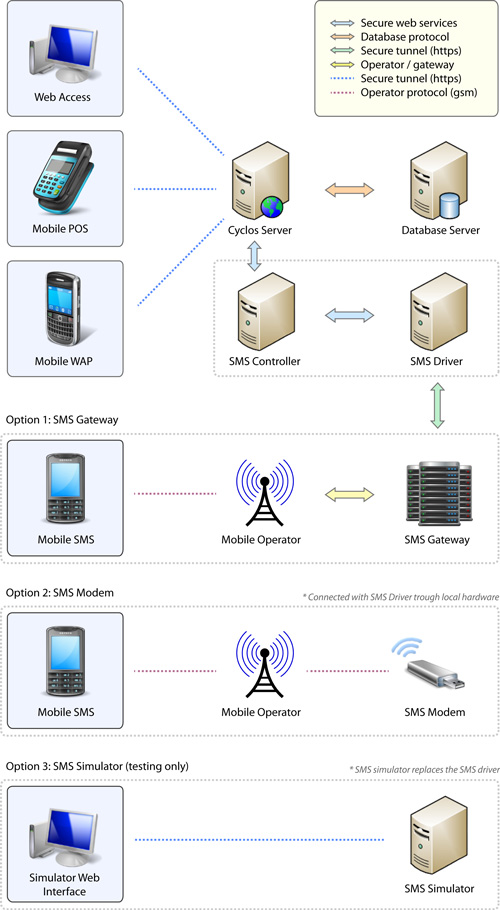
The SMS module is not an internal Cyclos component but is stand alone software, consisting of a Controller and a Driver. The Controller and the Driver are currently combined in the main installation package (All In One package). In the future we will publish also separate packages for the Driver and Controller.
Controller
The controller receives the messages (sent by users) and will also pass messages (the actual sending and receiving is handled by a 'driver', explained below. The controller serves as a bridge between Cyclos and the driver software. It handles the processing of messages, it parses messages, identifies the type of the operation (payment, account info etc), manages a session per operation, processes operations and sends return messages (confirmation, error etc).
Driver
The single task of the driver is to handle the communication with a (physically attached) modem or an SMS Gateway provider (GSP). The reason for developing the driver software was to decouple the controller from the complexities of different communication channels. Medium to large projects will commonly connect via a gateway provider, which offers higher security and scalability.
The GSP normally has contracts with mobile phone providers and will provide a single communication channel for message delivery and routing. The GSP will commonly provide additional services like delivery guarantee and a unique number for various operators. The outbound number will typically be an alphanumeric number (combination of numeric and alpha characters 0-9, a-z, A-Z) which means the receiver cannot reply. The most ideal situation would be a contract with one GSP that provides a single number (short code) for all TELCO's that operate in a country. In case the GSP does not offer messaging services for all TELCO's, additional communication channels and drivers can be configured. The Driver will need to be adapted to apply to the protocols and instruction set (API) of the GSP. The SMS module comes with a basic Driver that can be extended.
There are several driver 'Engines', a ModemDriverEngine that can be used for communication using a GSM modem, and a HttpGatewayEngine for communication with a gateway provider. You can also connect to a TELCO talking SMPP. You can add more Engines as you need them. The actual version of driver supports GSM modem through SMSLib and the other engines can work with HTTP or HTTPS connections.
The technical structures for messaging are available in most countries. Aside of the technical issues there are also juridical issues to consider. Every country has its own laws concerning communication services and messaging. The GSP's are usually aware of the technical and juridical issues. It will be therefore a matter of negotiating with the GSP's.
All In One package
The currently available SMS module for download is provided as an AIO package. The AIO package combines the Controller and Driver in a single installation, that is easier to install and administer. Another advantage of the AIO package is that controller and driver can communicate directly, without slow data exchange. Consequently, the webservice connection configurations do not apply. In the future separate Driver and Controller packages will be made available. Using separate Controller and Driver (instead of the AIO) is only useful for specific cases, for example having physical modems (connected to local Drivers) on different locations.
Command parameters
The part of the system that carry out an action is based on the idea of commands. A command is an entity able to carry out some task at the time a message arrives. It can take an action against a Cyclos instance, although it can answer the message by itself. There are different types of commands you can setup for every Cyclos instance. Each command is developed for a specific use case (see Operations).
Routing
In a typical installation of Cyclos + SMS there will be one controller/driver for one Cyclos instance. It is however possible to connect more than one Driver and more than one Cycos instance to a single controller. Because of this the controller must be able to route incoming (Driver > Cyclos) and outgoing (Cyclos > Driver) messages. For each message direction (incoming and outgoing) there are two mappings. The Cyclos to Driver mapping is done based on two custom fields defined for every member. One of those custom fields defines what the TELCO is. The other custom field defines the member's cellphone number. The mapping from the Driver to Cyclos has two levels, the first based on DriverId and TargetShortNumer, and the second level which, on top of the first level data, adds a prefix in text of the message to determine the Cyclos instance with which messages will be processed (more details in SMS routing).
Number / short code
An organization or company that implements SMS operations will typically have one phone number for outbound messages and one for inbound messages. The outbound number is used for messages generated by the Cyclos system, for example payment confirmations and mailings. The inbound number will 'listen' to the client messages, these are normally operations like payments or request for information. In order to provide easy memorizable numbers (and faster typing) the organization could contract 'short code' numbers.
Web Services
The communication between the controller and Cyclos is handled by web services. All web service are published in the URL <applicationURL>/services
Controller web services used by Cyclos
Payment request
Cyclos will invoke this operation to ask the Controller to confirm a payment request. It is published on <applicationURL>/services/paymentRequest with the next methods:
- requestPayment: Send the payment request message to the member. The Controller will generate a session in order to match the member confirmation response, otherwise the session will expire (there is a parameter to specify the expiration time).
- Input parameters:
- cyclosId (string): Cyclos instance identifier.
- ticket (PaymentRequestTicketVO): This ticket contains the payment information and the Controller will associate it to the generated session.
- Input parameters:
Notifications
Allow Cyclos to deliver notification messages to members. It is published on <applicationURL>/services/smsSender with the next methods:
- send: Used by Cyclos to send a notification to a member.
- Input parameters:
- cyclosId (string): The Cyclos instance identification (used by the Controller to route the message).
- SMS data (SendSmsSenderParameters): Data about sending SMS (like destination, text, traceId, etc.)
- Return: a boolean (true if sending was successful)
- Input parameters:
Controller web services used by Driver
Messaging
Allow the Driver to send a received message to the Controller. It is published on <applicationURL>/services/controller with the next methods:
- send: Invoked by the Driver to transfer a received message.
- Input parameters:
- message (DriverMessage):
- driverId: The driver identification. This parameter is used together with the message.to parameter.
- message (Message):
- from (String): The source cellphone number. This data is used by the controller to find the associated member.
- to (String): The driver endpoint where messages arrive (the short number). This data plus the driverId are used by the Controller to find the Cyclos instance to work with.
- text (String): The message's text.
- traceData (String): Identification to track messages
- message (DriverMessage):
- Input parameters:
Driver web services used by Controller
Messaging
Allow the Controller to send a message to the Driver. It is published on <applicationURL>/services/driver with the next methods:
- send: Invoked by the Controller to send a message.
- Input parameters:
- message (ControllerMessage):
- message (Message):
- from (String): The source short number.
- to (String): The target cellphone number.
- text (String): The message's text.
- provider (String): The provider must be used to deliver message.
- traceData (String): Identification to track messages e
- message (Message):
- message (ControllerMessage):
- Input parameters:
Cyclos web services used by Controller
Details about cyclos webservices used by the controller can be found in the documentation at Cyclos 3.6 web service interfaces